Wordkeep
A private, single-owner vocabulary archive that keeps words attached to the moments where they appeared, with encounter timelines, deliberate reviews, and review health.
Technologies
- TypeScript
- React
- Bun
- Hono
- PostgreSQL
- Vite
- Tailwind CSS
- TanStack Query
- Drizzle ORM
- RustFS
- Tesseract OCR
- Web Push
- Cloudflare Pages
- PWA
On this page
About the project
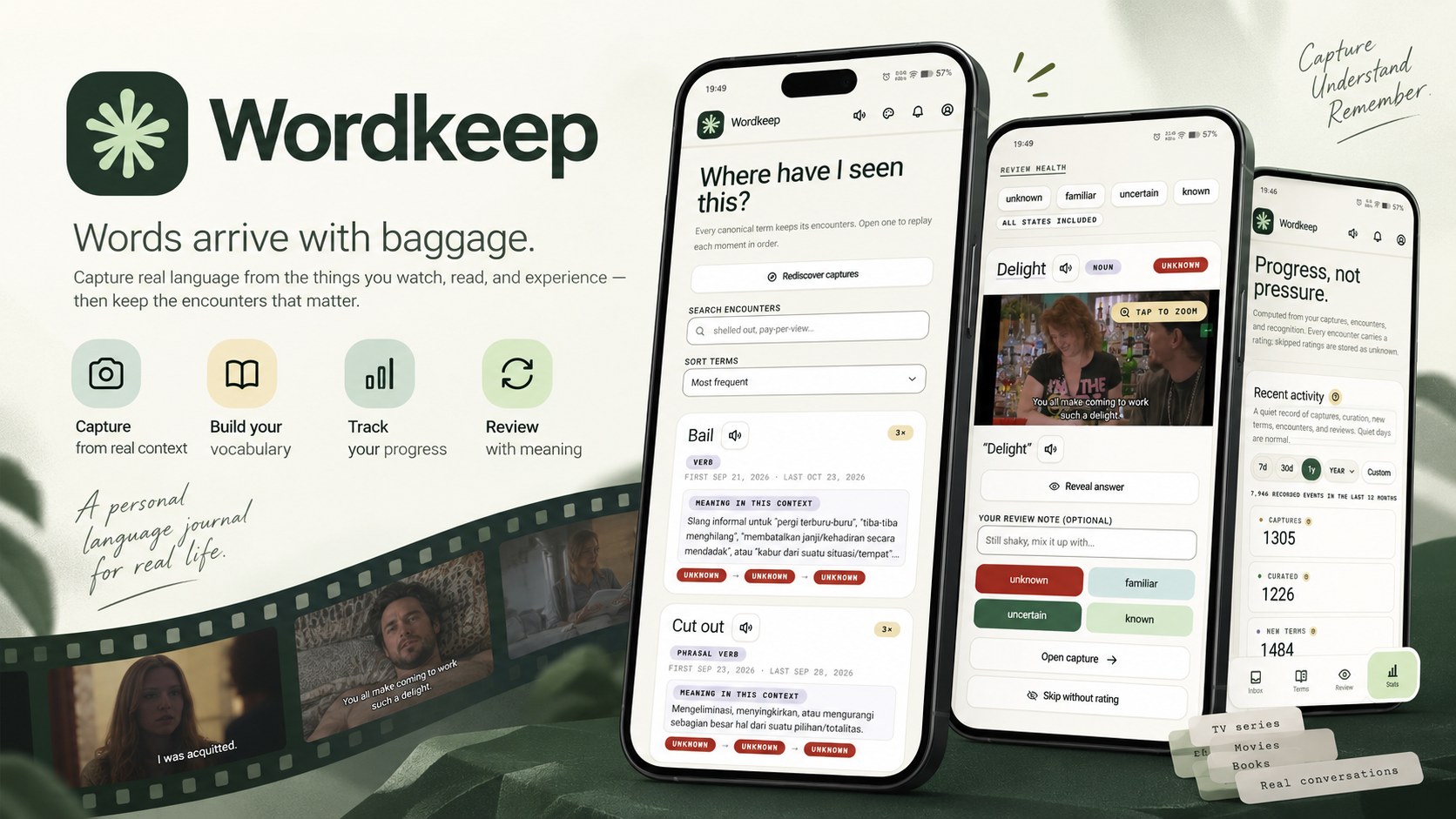
Wordkeep is a private vocabulary memory system built for one person: an Indonesian speaker learning English from films, series, articles, and conversations. It starts from a simple observation: a new word rarely arrives alone. It arrives inside a scene, a line of dialogue, a paragraph, or a conversation that gives it meaning.
Instead of turning words into isolated flashcards, Wordkeep keeps each term attached to the capture where it was found and to every later encounter. A screenshot or passage is saved first, and curation comes later. The owner records the canonical term, its part of speech, the meaning in that specific context, and a note. Reviews then bring the term back with its original scene rather than a bare definition.
The application is intentionally single-owner. There is no public sign-up, classroom, or social layer. It runs on desktop and as an installable mobile web app, with the same private archive behind both. The design principle is simple: record what happened. Do not manufacture a score.
Capture first, organize later
Sessions group captures from one activity or source: an episode, a chapter, an article, a game, or a conversation. A Session can carry source metadata such as a show, season, episode, or publication, and each capture can override those fields when the source changes mid-session. Captures that do not belong anywhere yet can stay ungrouped.
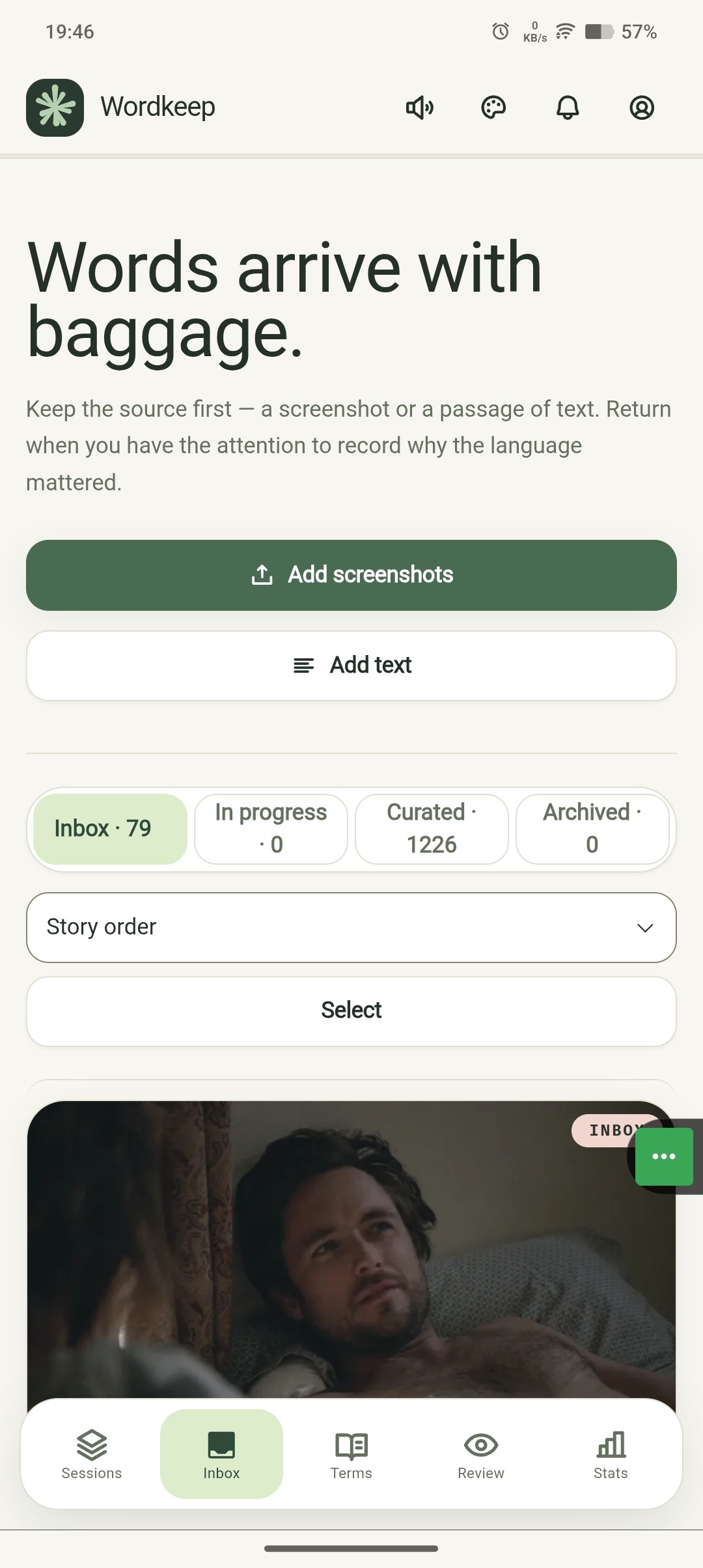
The Inbox is not another folder. It is a cross-Session view of captures by curation status: Inbox, In progress, Curated, and Archived. A capture can move between states without leaving its Session.
Screenshots can be added in bulk, up to 200 at a time, with a reviewable story order before upload, three concurrent uploads, and duplicate detection based on the image content hash. The upload queue keeps every file independent, so one failure does not sink the batch. Text captures cover articles and conversations where a screenshot would be the wrong container. On Android, Wordkeep is also a share target: a screenshot shared from another app lands in the capture flow.
A capture, end to end
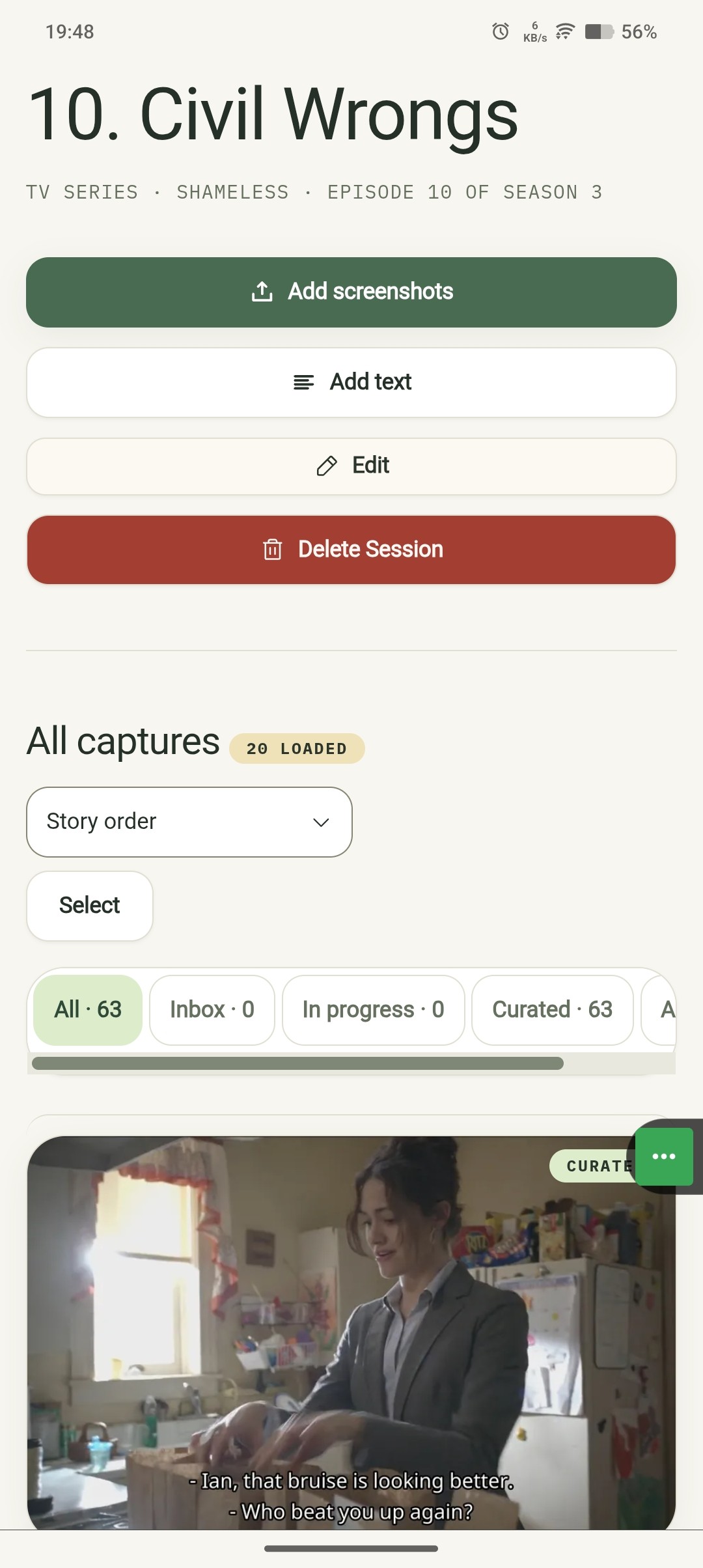
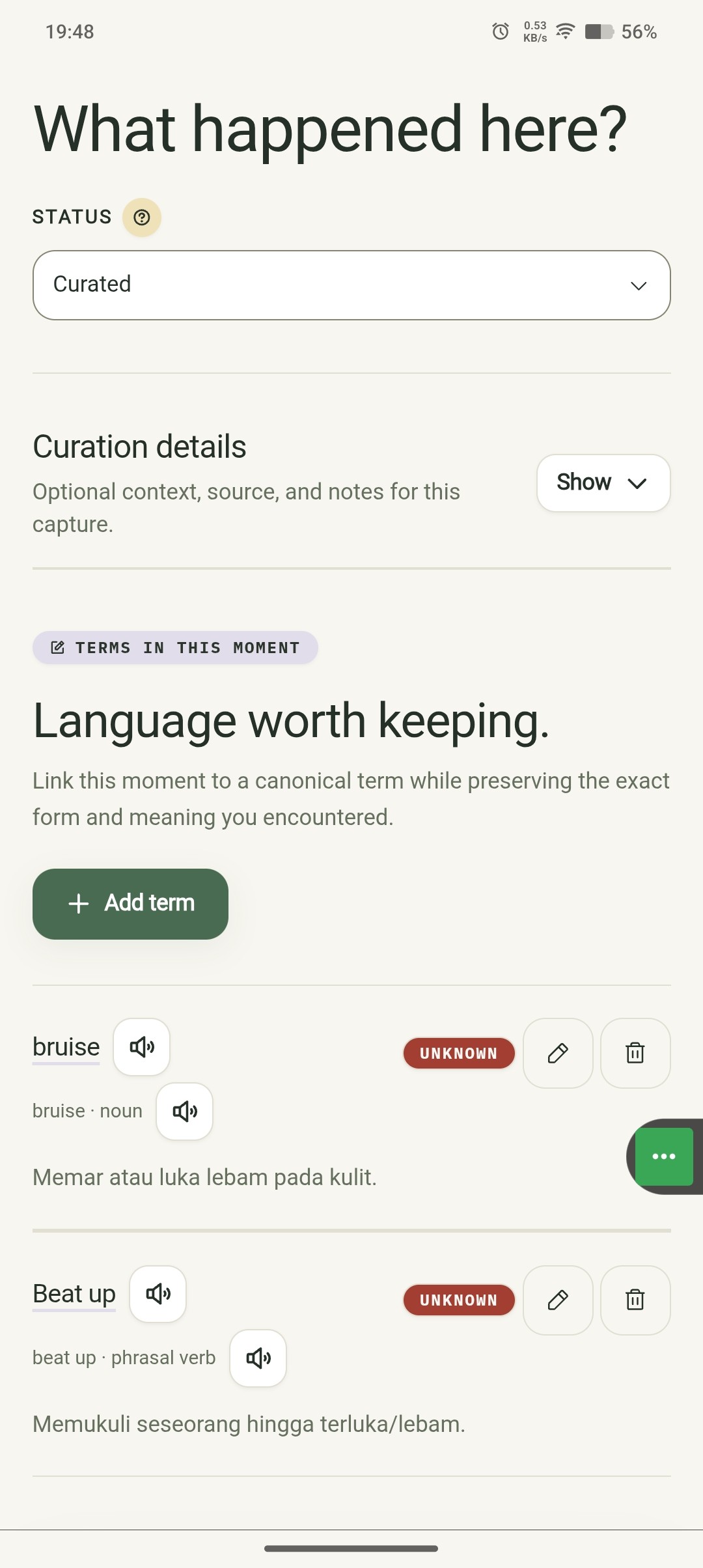
One capture in this archive comes from Shameless season 3, episode 10, “Civil Wrongs”. The subtitle reads: “Ian, that bruise is looking better. Who beat you up again?” One moment produced two terms: bruise as a noun, with the meaning “Memar atau luka lebam pada kulit”, and beat up as a phrasal verb, with the meaning “Memukuli seseorang hingga terluka/lebam”. Each keeps its own canonical form, part of speech, contextual meaning, recognition, and pronunciation control. The exact line stays as Context.
A capture can hold as many terms as the moment warrants. Source fields stay with the capture. Terms inherit the scene. When the same word appears again, a new encounter is added to the existing term instead of creating another card. That is how a word accumulates history: not one definition, but a sequence of places it appeared.
Subtitle transcription is the one place where Wordkeep automates capture. The manual reader crops the subtitle band and runs Tesseract OCR server-side. The result is editable before it becomes Context. A scheduled backfill can fill an empty Context only when the reading is English, confidently read (mean confidence at least 60 with no weak words), one to four lines, at most 300 characters, and not a bare sound cue. Weaker readings stay suggestions. OCR never writes meanings, translations, tags, terms, or recognition. It only helps preserve the line that was already on screen.
Terms with a memory
The Terms workspace searches terms and encounters: canonical forms, surface forms, meanings, notes, and capture context. Terms can be sorted by frequency, recency, alphabetically, or shuffled for rediscovery. Opening a term shows its encounters in chronological order, the source media for each one, and the recognition trail across them.
Part of speech is part of a term’s identity. Light as a noun and light as an adjective are separate terms with independent timelines, because they are different things to learn. When two spellings or forms turn out to be the same word, a merge moves the encounters and reviews to the surviving term and keeps a general note.
The Rediscover captures view reopens the archive by story order, oldest, newest, or random. It is a way to meet a saved moment again without starting from a word, which is useful when the exact term has been forgotten but the scene has not.
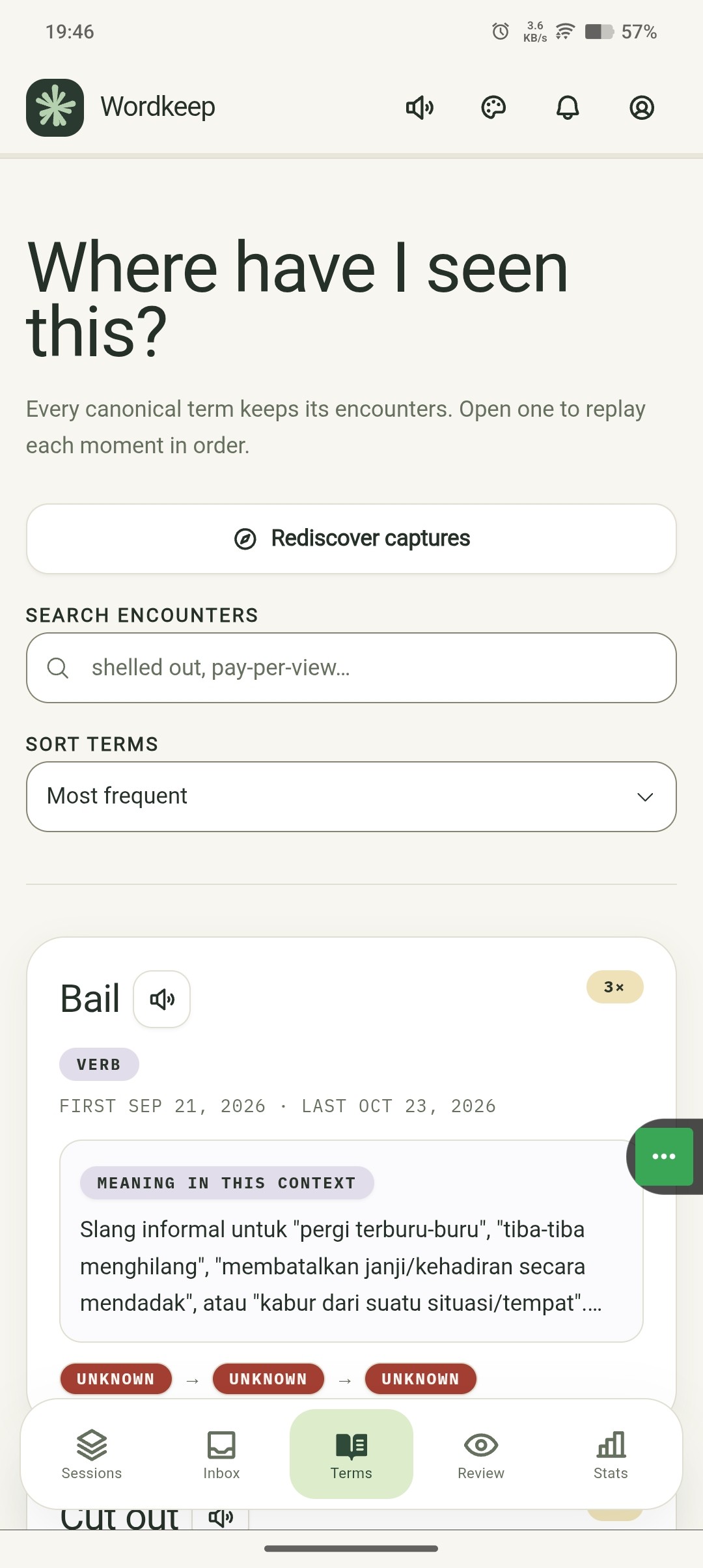
Bail is a verb with three encounters: first captured on 21 September 2026 and last met on 23 October 2026. Its recognition trail is still unknown, unknown, unknown. Wordkeep does not hide that. The archive shows how long the word has been carried, where it has appeared, and how often it has actually been met.
Deliberate review
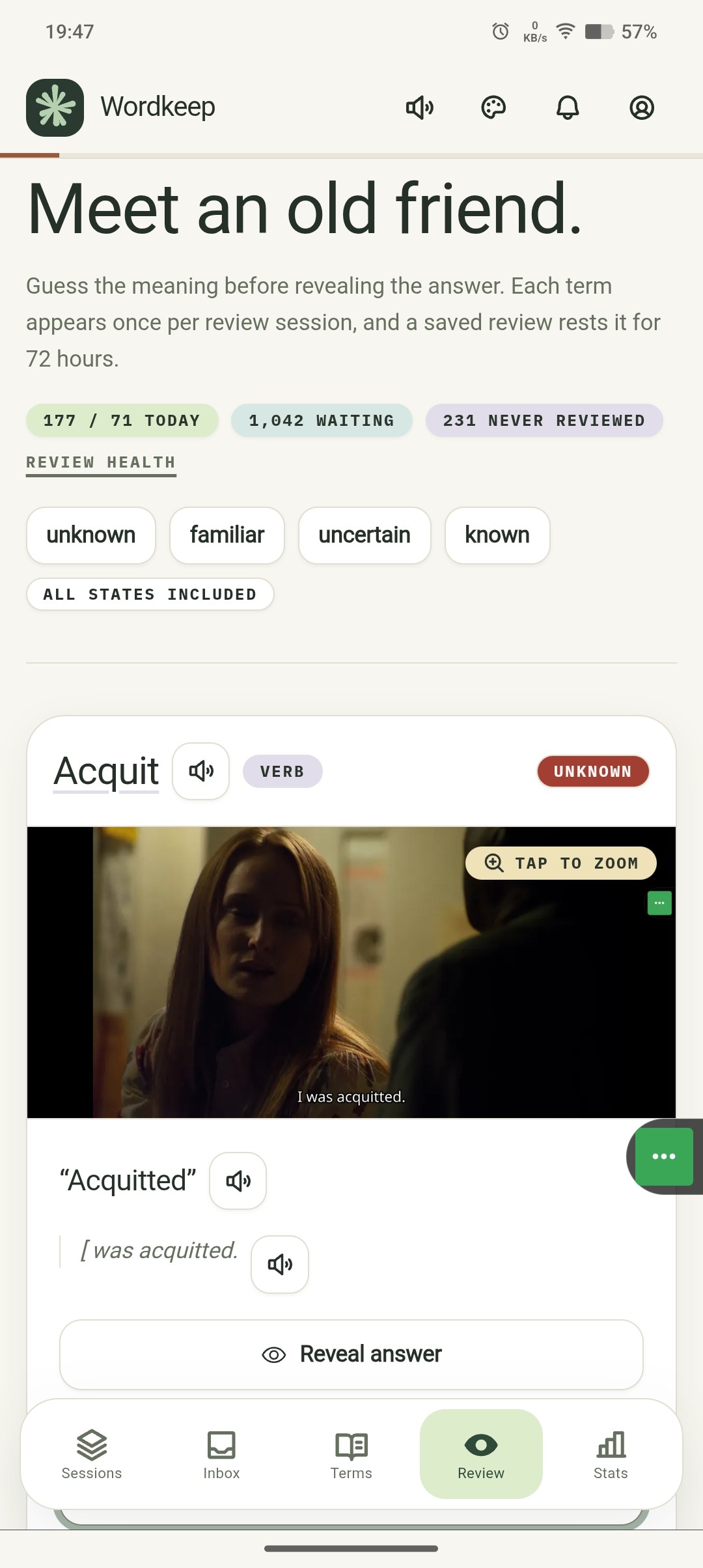
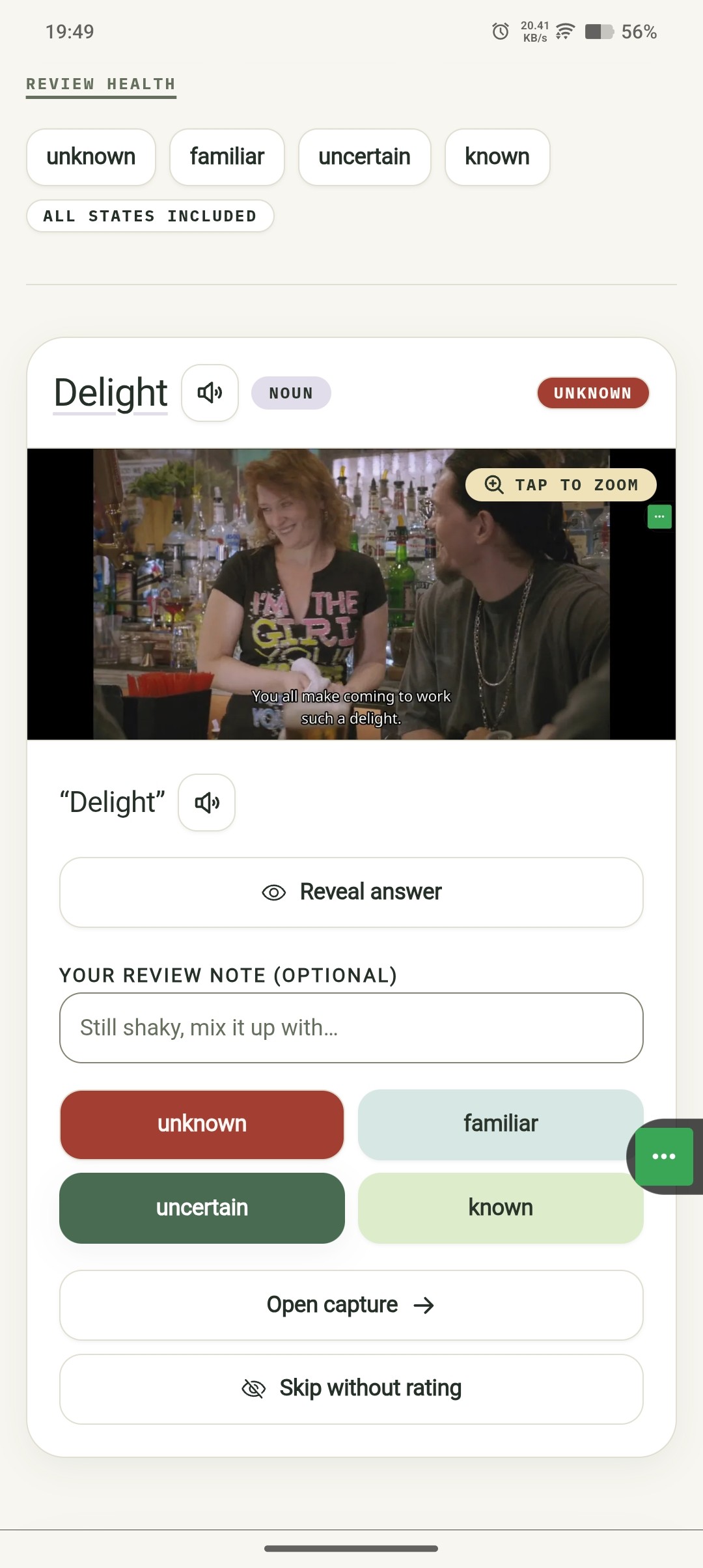
A review starts with a term and one of its saved encounters: a video still, a subtitle, a text passage, or a note. The meaning stays hidden behind Reveal answer so the owner can try to recall it first. Revealing exposes the meaning in context, the encounter note, and the first-encounter date. The card also offers an optional review note, four ratings (unknown, familiar, uncertain, and known), a link back to the capture, and a skip that records nothing.
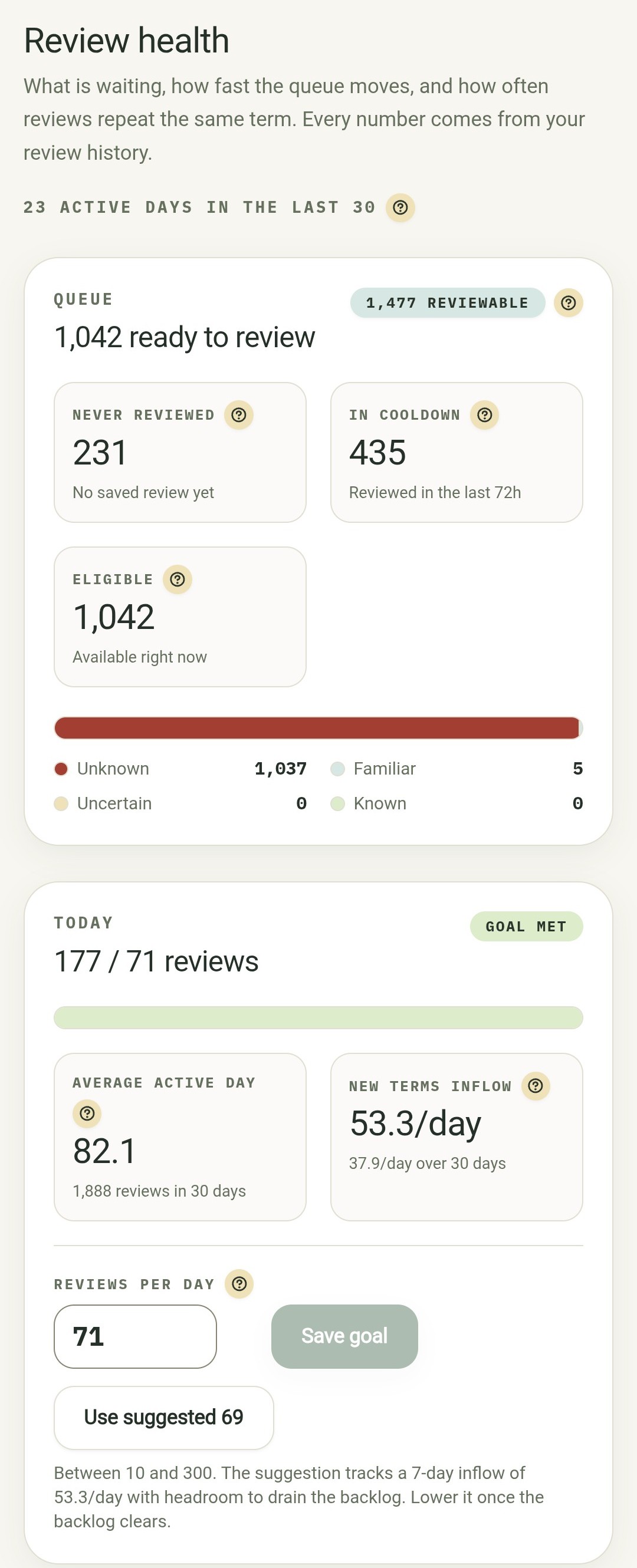
Each term appears at most once in a review session. A saved review rests the term for 72 hours before it can return to the queue, and the page can filter the queue by recognition state. The review header shows today’s count against the daily goal. At the time of this snapshot, 177 reviews had been completed today against a goal of 71.
Review records are deliberately kept apart from encounters. A review schedules the next check-in, but it does not rewrite the natural encounter history or the encounter-based statistics. That separation is what lets the archive distinguish between meeting a word in the wild and sitting down to test it.
On supported devices, review cards arrive through Web Push. The owner chooses an interval of 1, 5, 10, 15, 30, or 60 minutes and a quiet-hours window. The scheduler sends one term at a time and respects the 72-hour cooldown. On Android Chrome the notification offers Reveal and Known or Still learning actions, and the quick sheet carries all four ratings. On iPhone the card arrives without action buttons. When the queue is empty, the cards stop quietly.
Progress, not pressure
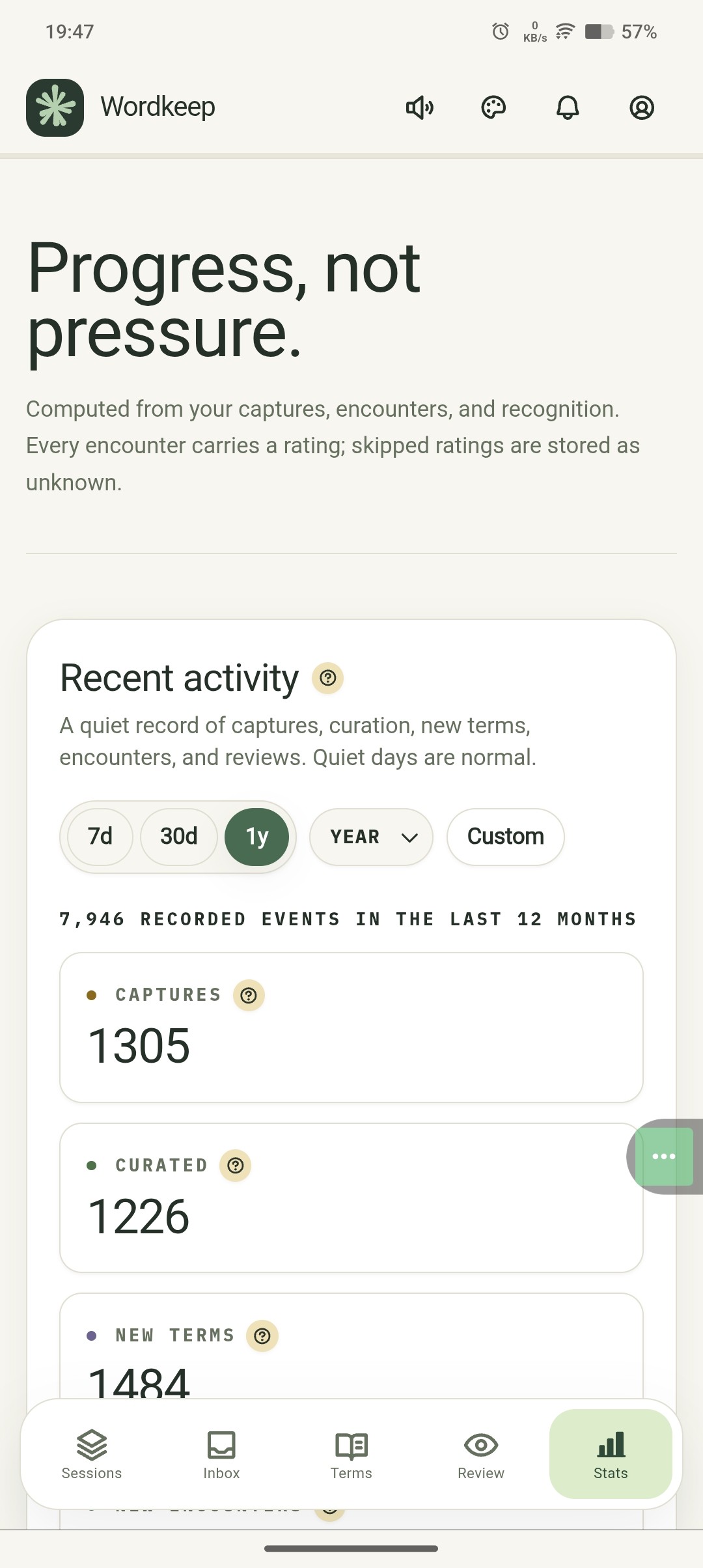
The Stats page is descriptive rather than judgmental. Recent activity counts captures, curated captures, new terms, encounters, and reviews separately across 7 days, 30 days, 12 months, a calendar year, or a custom range. Quiet days are shown as zero rather than skipped.
Weekly recap compares the current week with the previous one. Learned and Slipping summarize the natural encounter trail: Learned means the first-ever rating was unknown and the latest is known. Slipping means a term reached known at some point and later left it. The Coming due forecast, the review-hours chart, the transition matrix, and stubborn terms answer narrower questions about pacing and recall.
The archive can be exported as one JSON file containing sessions, capture records, terms, encounters, and preferences. Image bytes stay in private object storage and the export references them by object key.
None of these views turns a quiet day into a failure. The archive can show a term met repeatedly without pretending it has been mastered.
Review health
Review health is the most operational part of the Stats page. It reads the live queue and reports four things: what is waiting, how fast the queue moves, how often reviews repeat the same term, and what a given pace would do to the backlog.
At the time of these screenshots, 1,477 terms were reviewable: 1,042 ready now and 435 resting in the 72-hour cooldown. Of the ready terms, 231 had never been reviewed. The owner had completed 1,888 reviews in 30 days across 23 active days, an average of 82.1 reviews per active day. New terms were arriving at 53.3 per day over the last seven days and 37.9 per day over 30 days.
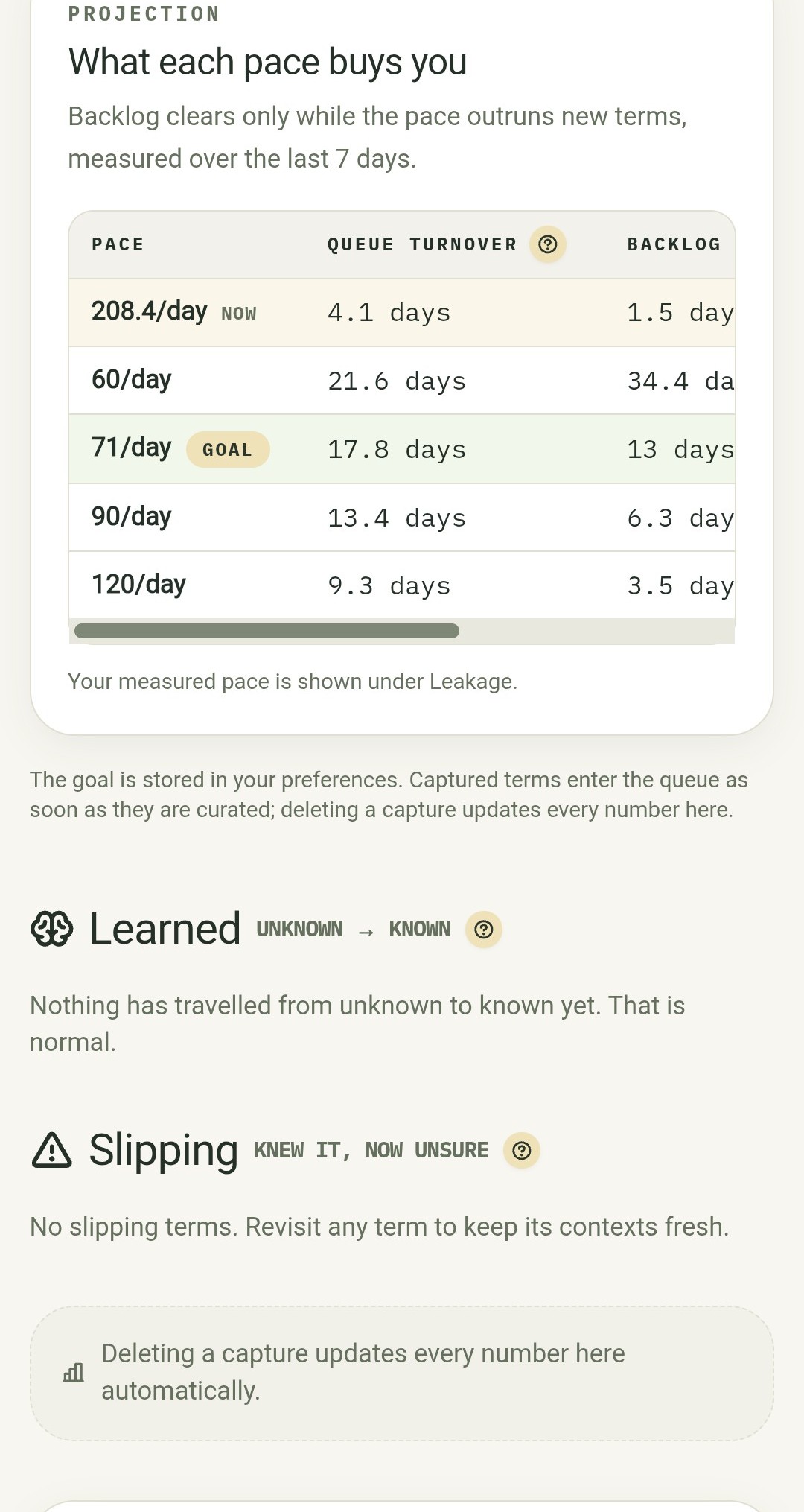
The projection table makes the trade-off legible. At the current seven-day pace of 208.4 reviews per day, the queue turns over in 4.1 days and the backlog clears in 1.5 days. At the saved goal of 71 per day, turnover stretches to 17.8 days and the backlog to 13 days. At 60 per day, the numbers become 21.6 and 34.4 days. At 120 per day, they fall to 9.3 and 3.5 days. The point is not to prescribe a pace, but to show what each pace buys.
Spacing and leakage explain why a large queue can still feel unproductive. The page reports the median gap between two reviews of the same term, the delay before a first review, same-day and same-sitting repeats, and the measured seconds between reviews inside a sitting. Stubborn terms, reviewed five or more times without reaching known, are flagged for a fresh context or mnemonic rather than another pass through the same queue.
An installable mobile workflow
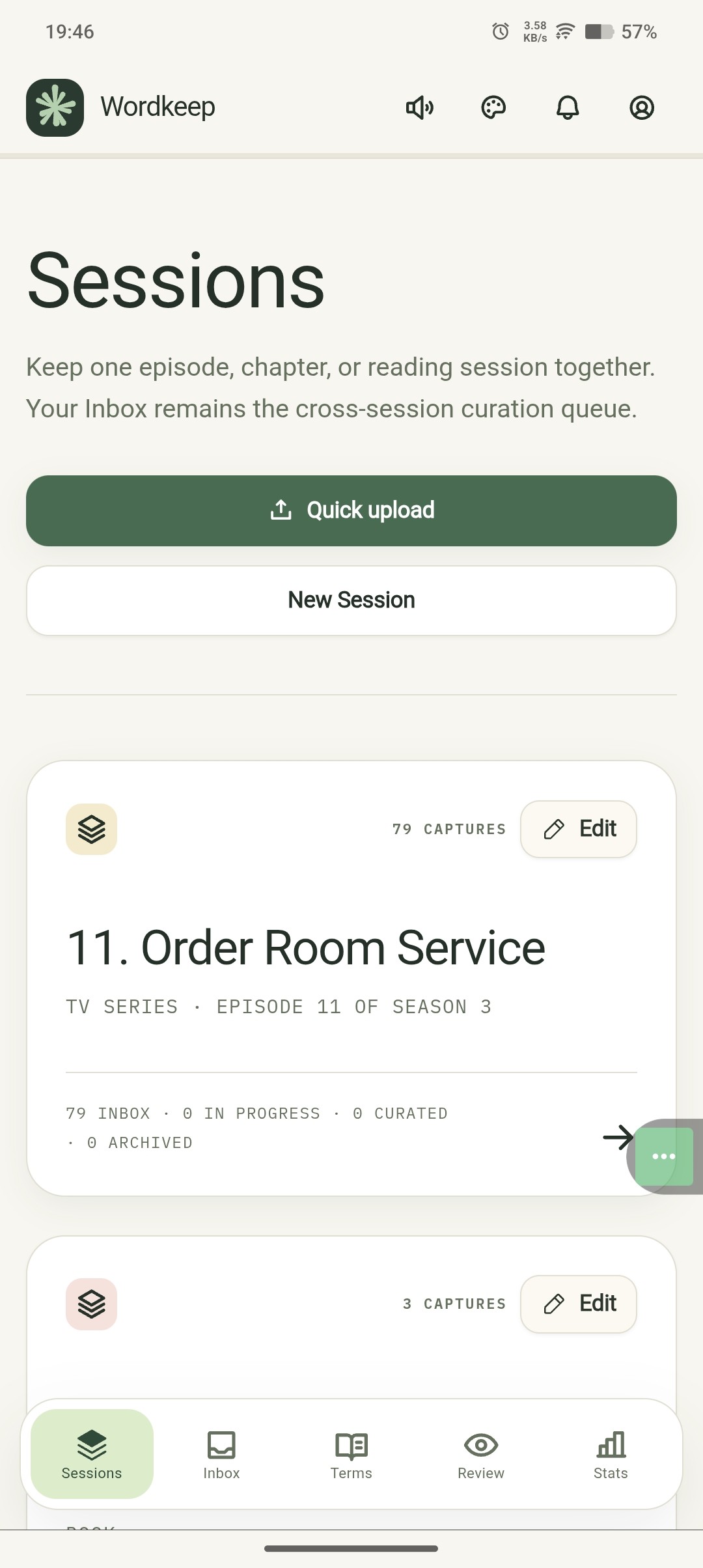
Wordkeep is a PWA. On Android, the Web Share Target accepts JPEG, PNG, and WebP images, so a screenshot can be sent from another app straight into the capture flow. The installed app keeps Sessions, Inbox, Terms, Review, and Stats one tap apart.
The service worker caches only the static application shell. API responses and capture media are never cached, so the app can open offline without pretending that private content is available offline. The Appearance dialog switches between seven skins, Studio, Terminal, Album, Garden, Editorial, Cinema, and Midnight, each in light and dark, and stores the choice on the device. Inside the app, pressing / focuses term search and ? opens the shortcut help.
Architecture and privacy
Wordkeep is a Bun workspace with two applications. The frontend is React 19 with Vite, Tailwind CSS v4, TanStack Query, React Router, and Radix-based interface components. The API is Hono on Bun.
PostgreSQL and Drizzle ORM store Sessions, captures, terms, encounters, reviews, preferences, and push subscriptions. RustFS provides private S3-compatible object storage. Sharp produces bounded display images, Tesseract runs on the API host for OCR, and web-push delivers review cards. Capture media is served through short-lived presigned URLs rather than a public bucket.
Authentication is a server-side session for the single owner, with an Argon2id password hash. The frontend is deployed on Cloudflare Pages, and a Pages Function proxies /api to the API on a VPS with a shared secret and the trusted client address. The proxy keeps the API same-origin for the browser, so session cookies work without exposing the API host as a separate origin.
The archive is private by construction: one owner, no public profiles, no third-party analytics, and no public media bucket. The service worker never caches API responses or capture images, and normal API responses omit object keys and content hashes. The owner-only export is the deliberate exception. Tests cover the API with Bun’s test runner and the web application with Vitest, including HTTP, integration, and component suites.
Trying Wordkeep
Wordkeep is not a public sign-up product. The archive is designed for one owner at a time. If you would like to try it, email adenafilfirmansah@gmail.com with a short note about what you read or watch, and I can set up a free trial and send you the details.